


Safeguarding Veterinary Staff: Pin-Zhan Animal Hospital Deploys AIRTECH System Co., Ltd. Fume Hood

Could general ventilation and air-cleaning systems alone provide the level of control required for increasingly specialized clinical procedures?
From General Ventilation to Contaminant Control at Source
Pin-Zhan Animal Hospital already had room ventilation and air-cleaning equipment in place. These systems played an important role in maintaining the overall indoor environment. However, chemotherapy drugs, pharmaceutical powders and other contaminants generated during specific clinical procedures require a different approach. As Dr. Huang explains, staff safety remains a primary consideration whenever new treatment services are introduced, as staff spend extended periods in a facility operating 24 hours a day.
Rather than allowing contaminants to disperse into the room before being removed, the hospital wanted to control them as close as possible to the point of generation. For a 24-hour facility where staff remain in the clinical environment for long periods, this represented an important step in strengthening workplace protection. The hospital therefore began assessing a local extraction solution designed to:
“Capture and remove airborne contaminants directly at the point of pharmaceutical handling.”
The Challenge: Effective Extraction Within Limited Clinical Space
One of the most significant challenges facing veterinary hospitals is space.
“Veterinary hospitals handle a very wide range of activities, so almost every part of the available space is already being used. Finding room for an additional fume hood can therefore be difficult.”
— Dr. Huang, Director of Pin-Zhan Animal Hospital
Unlike conventional laboratories, veterinary clinics must accommodate consultation areas, treatment rooms, surgical equipment, pharmaceutical storage and staff movement within a limited footprint. A conventional full-size laboratory fume hood was not the most practical solution for the hospital. Instead, Pin-Zhan required:
“A compact system that provides sufficient working space for a single operator, effective local extraction, a practical footprint, and compatibility with the existing clinical environment.”
The AIRTECH System Co., Ltd. Solution: Local Extraction Designed for Veterinary Applications
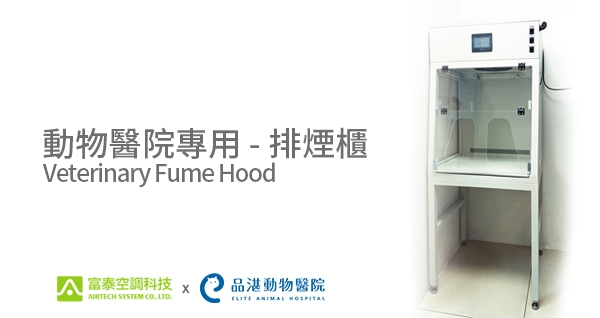
AIRTECH System Co., Ltd. provided a compact fume hood designed around the operational requirements of the veterinary environment. The system creates a defined working area where pharmaceutical powders, odors and other airborne contaminants can be captured close to their source before spreading into the surrounding room.
For veterinary hospitals, this provides several practical benefits:
• Contaminant Capture at Source: Airborne contaminants are extracted at the point of generation rather than being allowed to disperse throughout the clinical environment.
• Compact Single-Operator Design: The working area is designed to support individual operation while making efficient use of limited floor space.
• Reduced Dispersion of Pharmaceutical Powders: Localized airflow helps limit the spread of fine powders and airborne residues into surrounding work areas.
• Enhanced Protection for Clinical Staff: The system provides an additional engineering control for healthcare professionals who may spend extended periods in the same working environment.
• Complementary Air-Quality Control: Local extraction works alongside existing ventilation and air-cleaning systems, providing an additional layer of control specifically at the contaminant source.
Verified Performance Beyond Fan Specifications
The performance of a fume hood should not be assessed by fan capacity alone. To provide objective performance data, the AIRTECH System Co., Ltd. fume hood underwent independent third-party testing by SGS using methods referenced from EN 14175-3:2019, including airflow visualization, face velocity measurement, containment testing, and robustness testing.
Face velocity was measured at four points across the fume hood opening:
1.38 / 1.39 / 1.43 / 1.41 m/s
Average face velocity: 1.40 m/s
The close range between the four measurements provides quantitative information on airflow distribution across different working positions. For users, this is particularly relevant because operators may work at different points within the hood rather than remaining in a single fixed position.
SGS also carried out containment testing using SF₆ tracer gas. This provides a more meaningful assessment than simply confirming that air is being extracted, giving objective data on how the system manages airborne contaminants within the working area.
Testing Performance Under Simulated Movement
Veterinary hospitals are dynamic working environments. Veterinary surgeons, nurses and assistants regularly move around treatment areas, retrieve equipment and work alongside colleagues. Staff may also pass directly in front of extraction equipment during normal clinical activity. These movements can create local airflow disturbances.
To assess performance under more realistic conditions, the SGS evaluation therefore included robustness testing. During the test, a panel was repeatedly moved across the front of the fume hood to simulate external airflow disturbance. Tracer gas measurements were then taken to assess system performance under these dynamic conditions. The panel crossed the front of the hood six times, with the full test repeated twice. This type of assessment is particularly relevant to veterinary environments because it considers a question that static airflow measurements alone cannot fully address:
“Can airflow control remain stable when staff are moving and working around the equipment?”
“The Health of Our Team Has to Come First.”
Despite the limitations of available space, Pin-Zhan Animal Hospital placed staff wellbeing at the center of its decision. Dr. Huang explains:
“Even though space is limited, the health of our team remains the priority. We wanted a fume hood that did not require the footprint of a full laboratory system, but still provided enough space for one person to work while effectively capturing pharmaceutical powders.”
— Dr. Huang, Director of Pin-Zhan Animal Hospital
For Pin-Zhan, the installation was therefore not simply an equipment upgrade. It formed part of a wider approach to strengthening the working environment as the hospital expands into more specialized medical services.
When Should a Veterinary Hospital Consider Local Extraction?
Veterinary hospitals may benefit from assessing local exhaust ventilation or fume hood solutions in the following situations:
1. Introducing Oncology or Chemotherapy Services: Where specialist pharmaceuticals are being handled and additional engineering controls are required.
2. Regular Preparation of Powdered Medicines: Where fine pharmaceutical powders may become airborne during preparation or handling.
3. Staff Spend Extended Periods in Clinical Areas: Particularly relevant to 24-hour veterinary hospitals, critical care centres and continuously staffed facilities.
4. Existing Air-Cleaning Systems Do Not Address the Contaminant Source: General room ventilation and local extraction perform different functions and can be used together as part of a layered air-quality strategy.
5. Clinical Space Is Limited: Compact fume hood solutions can be planned around actual workflow, operator requirements and available space rather than relying on conventional laboratory-scale equipment.

